
Seminars
Seminars are intended to foster team building and provide professional development for HTU Student Representatives Units. Student Representatives Units may organize one seminar per year for this purpose. In addition, the HTU typically organizes the HTU Seminar once a year, which is open to all HTU volunteers.
Seminars can be held with or without facilitators. If no facilitators are involved, the seminar plan must be submitted to the HTU in advance. If facilitators are involved, a general outline of the content (e.g., team building, communication, legal matters) is sufficient. For groups of twelve or more participants, it is recommended to schedule two facilitators. In addition, you should consider how much leeway to give them in designing the seminar: While fixed times (e.g., for meals) are helpful for larger seminars, it is equally important to allow the facilitators sufficient flexibility—they know best how to carry out their tasks. Qualified facilitators can be found on the BV’s list of facilitators or in the facilitator directory. If you wish to use trainers who are not on these lists, you must provide justification to WiRef; this is possible in exceptional cases.
Three-day seminars (Fri–Sun) are standard. A four-day seminar offers the advantage of two full working days, as the first and last days are usually used for the introduction and conclusion. However, the costs are correspondingly higher.
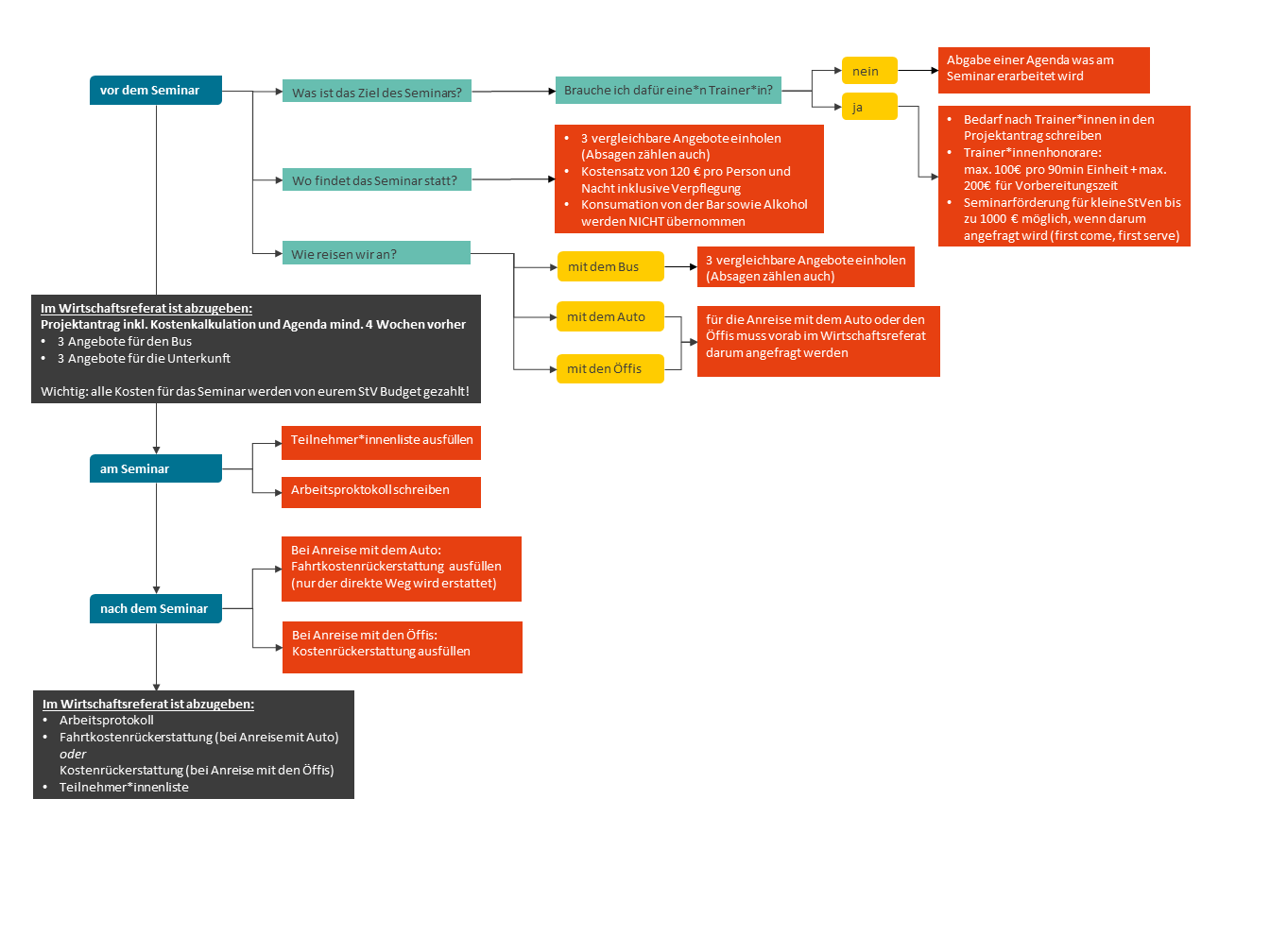
Seminar Planning
This diagram can help guide decision-making during the planning phase and throughout the overall process.
Download the diagram as a PDF. (Currently only available in German)
For the organization
Before the seminar
- Find seminar accommodations
- Organize travel arrangements: e.g., carpooling, public transportation, chartered buses, etc. (-> Don’t forget to get quotes for buses)
- Forward basic information to the department for financial affairs (When? Where? How many?)
- Do not make any commitments until the project proposal has been approved!
- Inform participants of departure and arrival times. It is advisable to arrive at the seminar location one hour before the seminar begins.
- Notify the facilitators well in advance of the seminar’s start and end times, as well as the final number of participants. A preliminary meeting with the trainers may be helpful.
- Clarify with the trainers what materials they need and who will provide what.
- Order a seminar package from Renate.
- Discuss evening activities with the accommodation provider: whether participants may consume their own beverages, whether an additional common room is available, and what sports and recreational activities the accommodation offers, etc.
- Give this information to the participants as well.
About a week before the seminar
- Notify the accommodation provider of the final number of participants and provide information about dietary preferences (e.g., vegetarian/vegan, special diets, allergies, etc.).
- Provide participants with a general overview of the seminar’s schedule and content. This helps avoid false expectations and frustration. Communicate what materials participants need to bring themselves (e.g., notepad and pens, laptop, outdoor clothing, etc.).
At the seminar
- Make sure the trainers have everything they need (just ask).
- Coordinate meal times with the kitchen.
- Review the bill with the accommodation provider and make sure the billing address is correct; otherwise, there will be problems with billing. Also, make sure no bar charges appear on the bill.
- Fill out the participant list and have it signed.
- If necessary, distribute travel expense forms and have them filled out.
- Last day: Tell the participants when they need to vacate their rooms. Check that all keys have been returned.
After the seminar
- Submit the list of participants, travel expense forms, and other invoices to the department for financial affairs.
- Submit the seminar minutes to the department for financial affairs.
- Write down tips and notes for future organizers and make them available (e.g., via the cloud).
For participants
The most important things for participants to know are when the seminar starts and ends, how to get to the venue, and what to bring. Here are a few tips:
What should you pack?
- Slippers and comfortable clothing
- Sturdy shoes and outdoor clothing
- Drinks and snacks for the evening
- Possibly supplies for the sauna (available at many seminar accommodations) or swimming pool
- Games and music for evening activities
- Writing supplies (a notepad and pens are usually sufficient); for workshops, a laptop if needed