
REPORT PRELIMINARIES PLANCKS 2024
And yet another legendary Plancks weekend came to an end far too quickly. But what exactly happened?
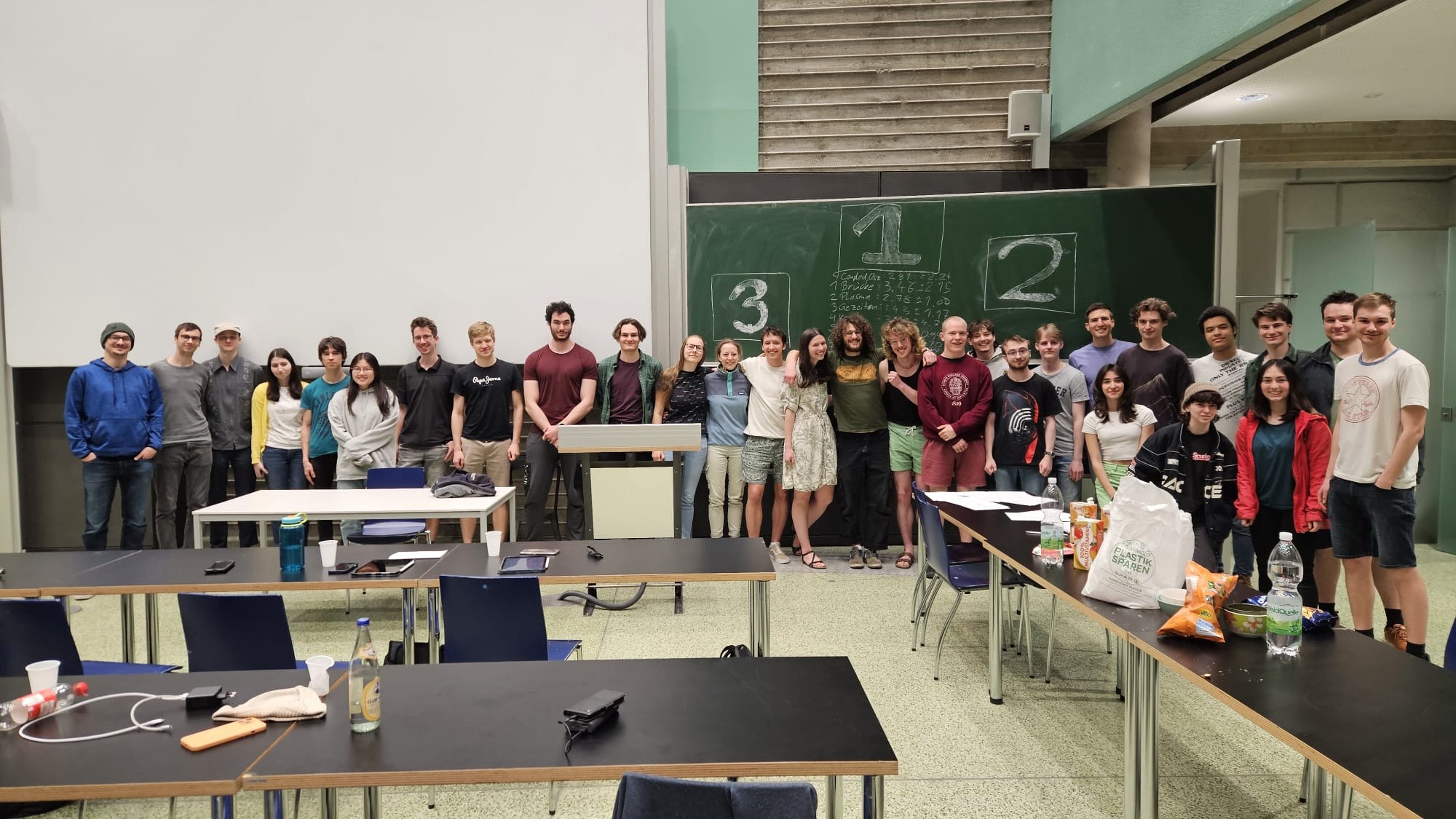
Just like last year, eight teams set out once again this year to claim the coveted victory and, with it, the sponsored (!) international spot in Barcelona. We counted five teams from Graz (University and TU), two from TU Wien and the University of Vienna, and one team from Linz. We got to see many familiar faces again—which made us especially happy.
After a brief reception with rolls, which were devoured immediately (I didn’t get a single one), we got right down to business. But before we got down to business, we were shocked to discover that the young people’s calculators can now both integrate and diagonalize matrices. We had gotten old. The calculators of our youth didn’t even have a sine button. We decided to solve the problem by requiring intermediate steps during integration.
After this incident, the participants were led to their respective rooms, where they had to solve nine highly challenging problems under supervision. A total of 102 points were up for grabs—a feat that would have been a challenge even for Einstein given the level of difficulty. Matthias, Johannes, Martin, and Markus Aichhorn, the authors of the problems, were definitely in top form. The problems spanned all areas of physics. A falling ladder loop, bouncing balls, ion traps, neutral atoms in a laser field, relativistic quantum mechanics, a pulsar… enough to make any serious physics fan’s mouth water.
After the participants had tackled the countless sub-tasks, it was time—once again—for dinner. Wait, before that there was a pub quiz, which Hannes, our good soul (who, by the way, also produced the legendary trailer—yes, the one we’re still talking about today, see ), had lovingly put together with ChatGPT. Almost all the questions revolved around particle physics. The connection was “The Standard Model.” ChatGPT is probably getting a little tired too.
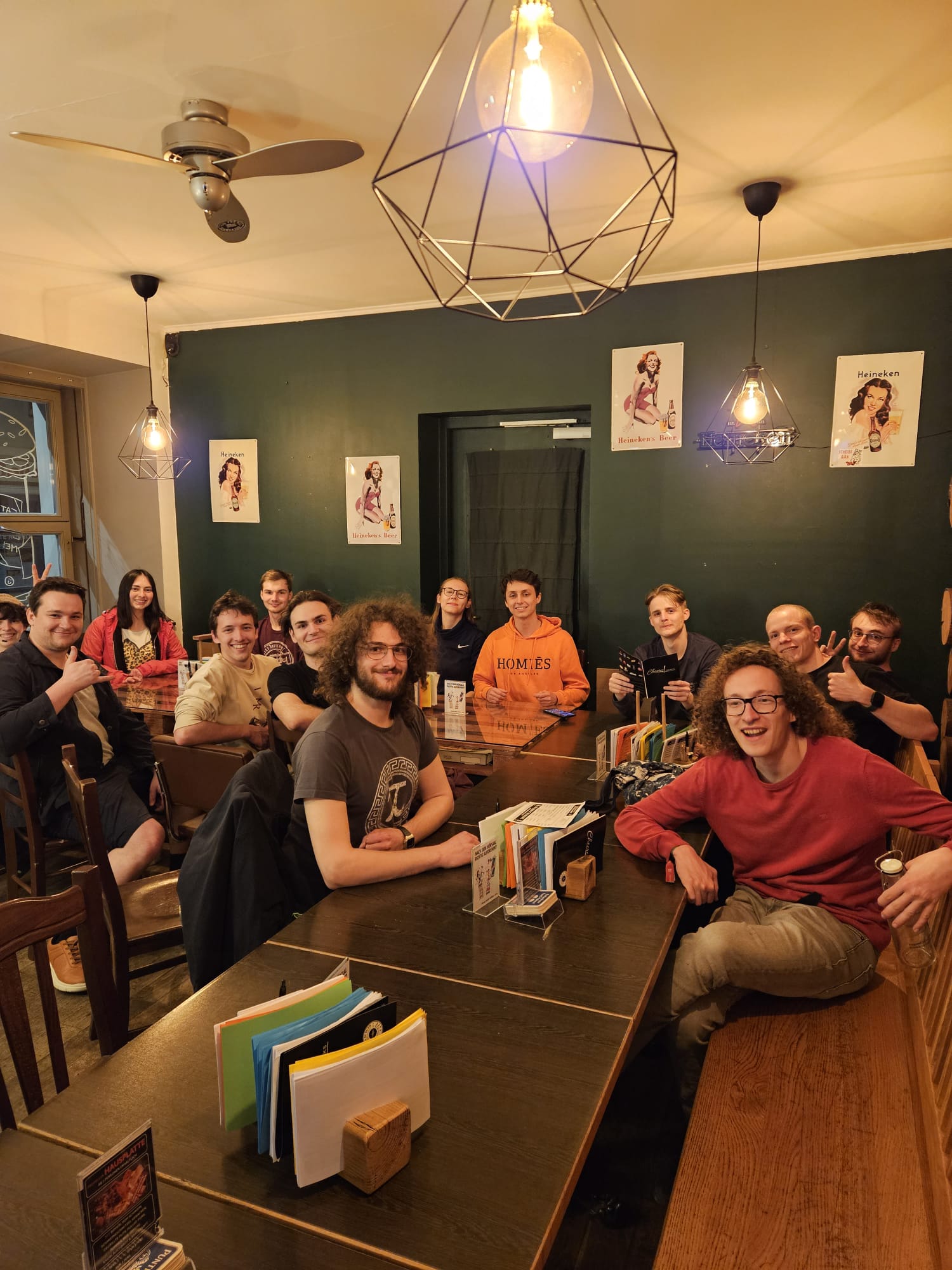
But then, for real: off to the long-awaited dinner at Gösser Bräu. The menu was very trendy, almost alternative: goulash, schnitzel, and cheese spaetzle. The winners of the pub quiz (yes, with three z’s!) even got a free alcoholic drink. When Lukas entered the room, the president of the Pauli club finally received the well-deserved applause for his fantastic organization! Afterward, all participants were forced to follow us on Instagram and watch the trailer. Since Lukas and I hadn’t managed to do the math that day (but still really wanted to), we had to emphasize several times that spoilers carry the death penalty. This threat had an effect, and so the examples weren’t actually an issue during dinner.
We shouldn’t fail to mention the efforts of Matthias and Martin—the unpopular coach from the trailer—who were still correcting examples that same evening after dinner.
As we happened to walk past the window, we witnessed Martin flying into a rage because a team hadn’t written his name on the slip of paper. And even though the handwriting made it easy to identify the slip, he wouldn’t stop fuming.
The next day, the solution review began, during which Matthias worked through all nine examples in 50 minutes—impressively proving that the examples weren’t actually that difficult.
Before the awards ceremony, there was a cheese platter, for which I had gone to XXXLutz the day before (!) specifically to buy a board on which to serve it. Once again, I didn’t get a single piece. At this point, one might well question the participants’ manners. But well, maybe we should have bought more.
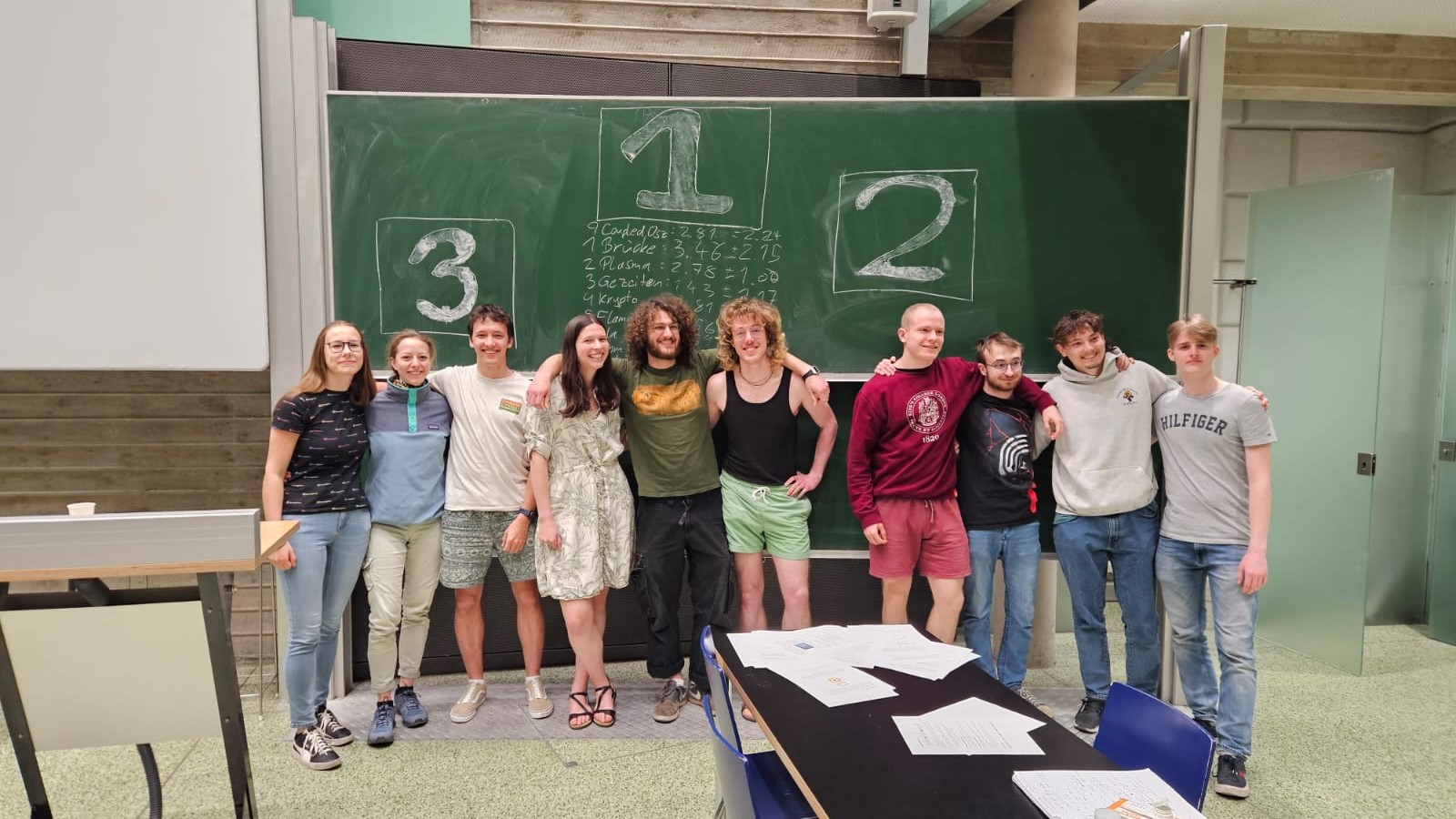
The award ceremony itself was as suspenseful as it gets. Bar charts shot up—only to stop just short of the red line, unfortunately. Once again, the professors couldn’t be beaten. That hurts. With 21.5 points, they edged out My Personal Favorites. By the way, the end of the last sentence isn’t a grammatical error, but actually the team name of Dani, Jan, Olga, and Mira, who—just like last year—won the competition and will now embark on the fully sponsored trip to Barcelona. Represent Austria with pride!
With 15.25 points, they came out on top ahead of Die Menseraner from Linz, who scored 14 points, and Team Vectorious, who also scored 14 points. Special mention goes to the performance of my personal favorites (please pick a different name next time, haha) on Example 1, where they scored a whopping 7 points. No other team scored that many points on a single example. Maybe the examples were a bit too challenging after all…
A big thank you, of course, goes to all three professors: Markus Aichhorn (who also contributed an example), Enrico Arrigoni, and Viktor Eisler. Without you, the event would only be half as fun! Lukas and I also tried our hand at the examples on Thursday after the Plancks weekend. We already knew they weren’t exactly a walk in the park, so we had a slight—but unfair—advantage. Still, let’s be clear: even we wouldn’t have beaten the professors.
Because, just like last year: Enrico shone again. For the second example, the average score was around 2.0, and he scored 9.5 points. The analytics wizard struck again and defeated Kapitza’s pendulum. He has already announced that he’ll be back next year. We’re looking forward to it!
But if we’ve learned one thing, it’s this: The true hero of this competition lives in Silicon Valley and was trained with 10^14 tokens (which is an order of magnitude more than Viktor Eisler, the Hungarian robot). ChatGPT scored 70% of the points. The only one who could beat it on one example (namely, as mentioned, Example 2) was Enrico.
Next year we’re moving on to Vienna, where we’ll do our very best to put together a team of professors. Maybe then it’ll be: VIENNA VS. GRAZ! With that in mind: See you next year at what’s sure to be an even cooler event.
We can hardly wait. We hope to see all the teams again—and that we’ve inspired you to start training in the meantime. The professors are probably doing it too by now. So you’ll have to work twice as hard.
See you next year,
PAULI!
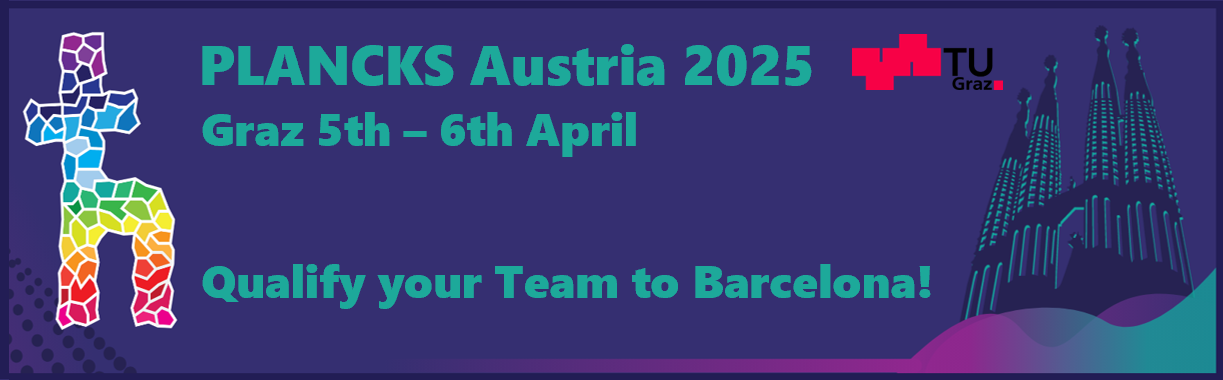
PLANCKS is a global physics competition for undergraduate and graduate students. The international finals are held in a different university city each year—this year in Barcelona. To win, your team of three to four members must solve ten fascinating and educational problems from a wide variety of physics fields within four hours. You’ll be competing against up to 50 teams from around the world. Represent Austria at the Physics Olympics! However, each country can be represented by only one to three teams. Therefore, only the best teams from each country can fly to Barcelona. These are determined through national qualifying rounds. This year, the Austrian qualifying round will be truly unique, as you’ll be competing not only against your fellow students but also against your professors! Curious? You can find more information and the registration form at https://plancks.at/
REPORT PRELIMINARIES PLANCKS 2024
We look back on an eventful 2024 preliminary round! Eight teams from across Austria (Graz University of Technology, University of Graz, Vienna University of Technology, University of Vienna, and JKU Linz) tackled nine challenging problems spanning the field of physics. From suspension bridges and Earth’s tides to the particle trajectories in a fusion reactor, the propagation of a flame front in a tube, the quantum mechanical detection of a bomb, and cutting-edge topics like quantum cryptography. These challenges left no one dry-eyed (from joy and also from despair 😉)!
As is the case every year, the goal was to secure the coveted spots in the international competition, which is taking place in Dublin this year. The number of spots is determined by the number of competing teams within a country, with a second spot awarded if there are 11 or more teams and a third spot if there are 35 or more. This year, with only 8 teams, Austria was allocated just one spot, and so the first-place team, Hipp, qualified after achieving an outstanding 43.5 out of 109 points (yes, the examples were challenging). Congratulations to Mira, Olga, Jan, and Dani—a strong performance, and good luck in Dublin. Represent Austria with pride!
Second place went to Team Obst from the University of Vienna with 28.75 points. They scored an incredible 12.5 out of 13 points on the quantum cryptography problem! Third place went to Team Krebs from Graz University of Technology with an outstanding 23 points.
But that’s not all. For several reasons, this year’s competition was a historic one. For the first time, there was a team consisting of two professors, as well as a team of two PhD students, who challenged the bachelor’s and master’s teams. Of course, the two special teams cannot advance to realize the age-old dream of a physics-focused vacation in Dublin. That privilege is reserved for the winners (Dani, Jan, Olga, and Mira) 😉.
The team of professors, consisting of Italian analytics “wizard” Enrico Arrigoni and Hungarian “computing machine” Viktor Eisler, scored 45.75 points, narrowly beating the winning team. Particularly noteworthy was their performance on the plasma example, where they scored 12.75 out of 13 points—a result no other team was able to match.
So we’re calling on all student teams: Don’t let this defeat get you down—come back next year. You’ll likely have a chance for revenge in an even more historic setting!
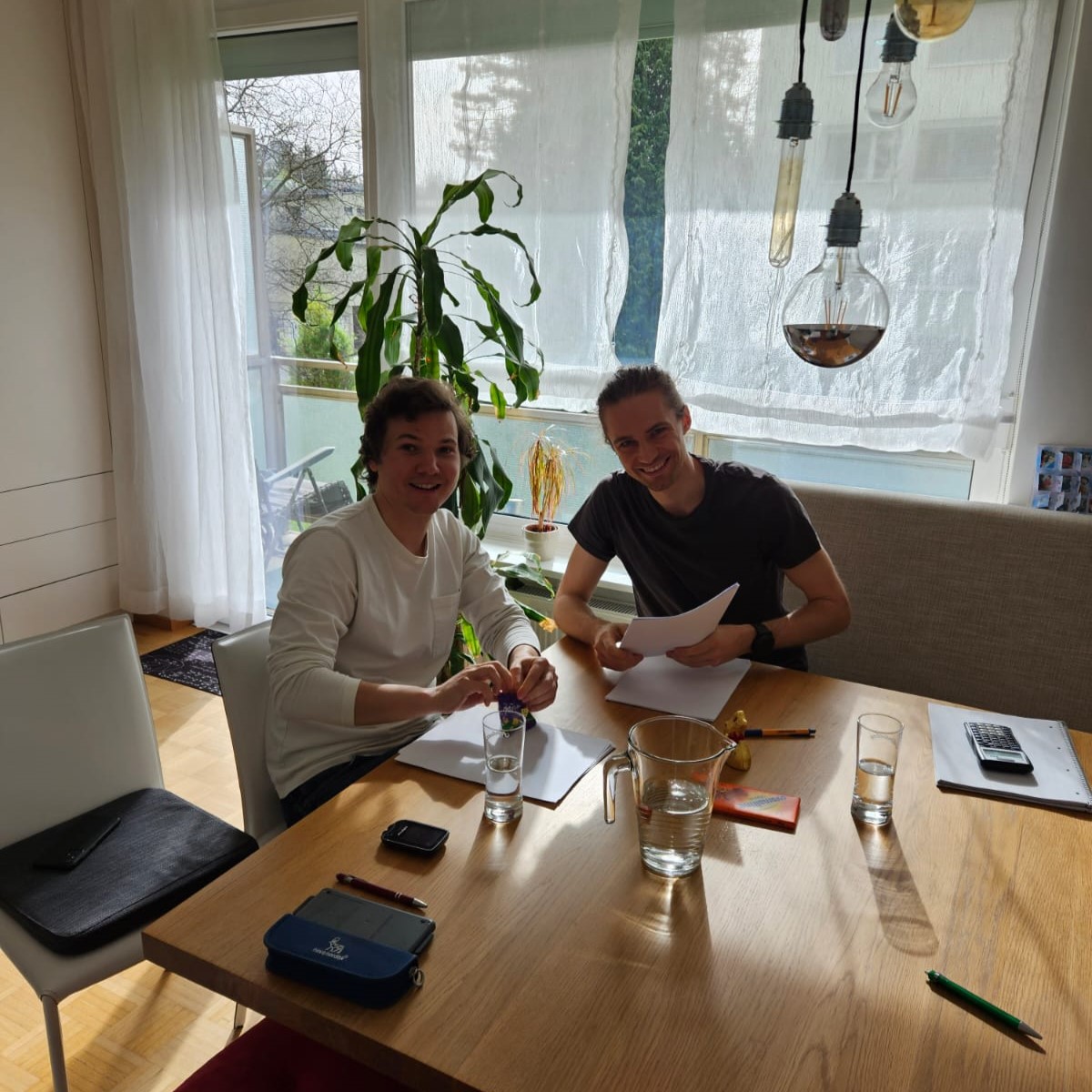
But wait, wasn't there something else? Oh right, the PhD students Johannes Krondorfer and Matthias Diez—part of the legendary team “DerAlteKannsNichtLassen,” which in the past had caused both a sensation and some embarrassing moments on the international stage (depending on their mood that day). The two scored an impressive 55 points, leaving even the professors in the dust. Great job, guys. (You don’t usually see them as cheerful as they look in the photo.)
This concludes our brief report. The organizers—Christian, Lukas, and Felix (examples, on-site support, and awards ceremony) and Matthias (overall organization)—would like to thank all participants and, of course, the Physics Student Group for their active support. None of this would have been possible without you—thank you for dedicating part of your weekend to this event. We would also like to extend our heartfelt thanks to the professors who participated or provided examples (Markus Aichhorn, Enrico Arrigoni, Viktor Eisler).
See you next year,
your organizing team!