

What is the Basisgruppe and what does it do?
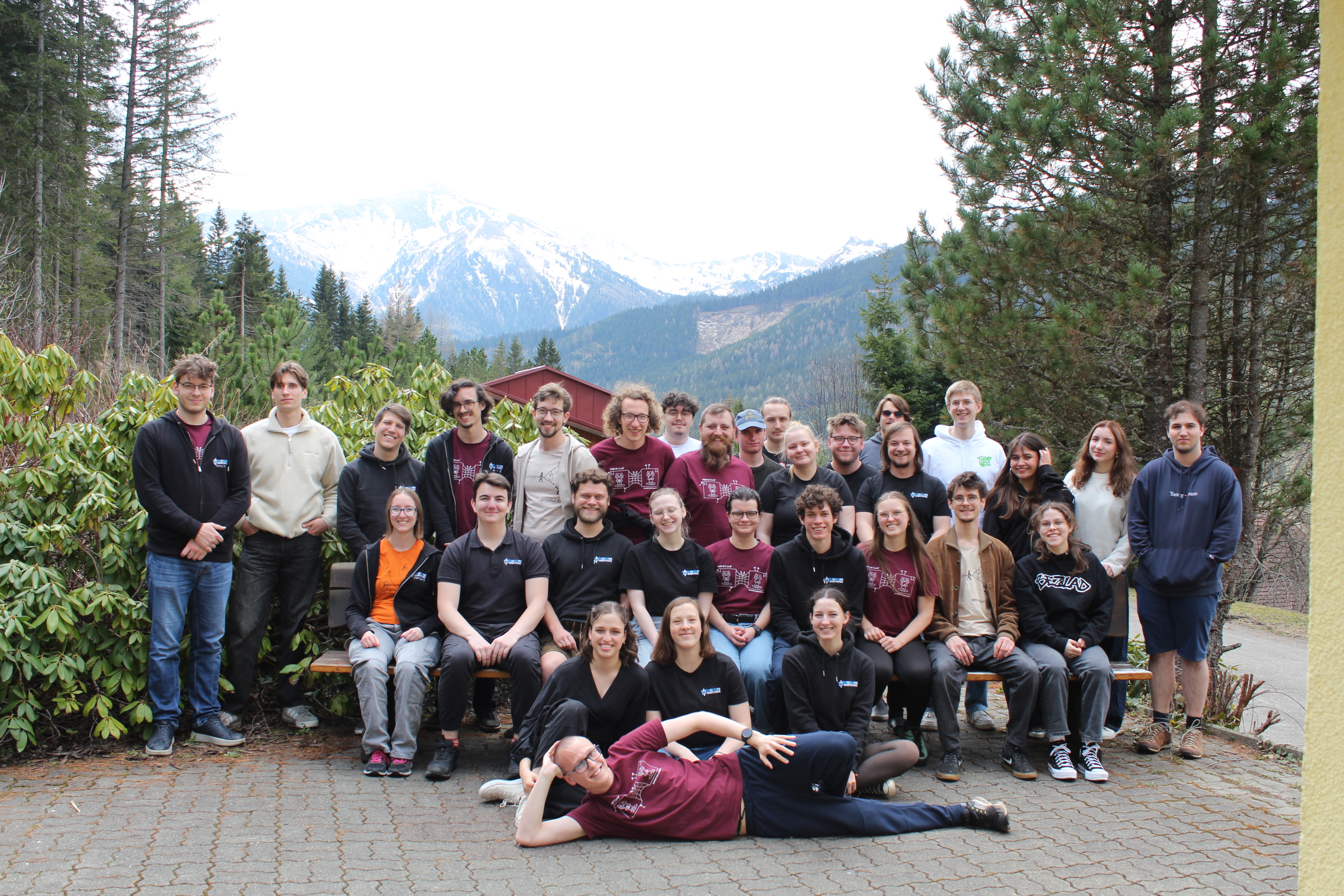
The Basisgruppe is an association of physics students and is open to anyone who wants to work towards improving study conditions. Its members also include the elected student representatives.
Activities of the Basisgruppe
- First point of contact for physics students: If we cannot help you with a particular issue, we can at least refer you to the relevant person or department.
- Student representation in study and curriculum committees: These committees are working groups of the Senate, with one-third of their members being students. Changes to the study programmes are decided in these working groups.
- Student representation on habilitation and appointment committees: Student members of these committees provide a didactic assessment which influences the subsequent procedure for granting teaching authorisation (habilitation) or awarding a professorship (appointment).
- Acting as a liaison with lecturers: If a direct conversation with a lecturer is not sufficient, the Basisgruppe can try to mediate.
- Organising First-Year Students consultations and tutorials: Every year, the Basisgruppe organises the ES-Tut with the help of many senior students to help new students settle into their studies.
- Organisation of events: from the vineyard-ralley, mulled wine stand and the physicists’ barbecue to cinema trips or games evenings
- Organisation of excursions: e.g. CERN – Geneva, ESA – Cologne, FRM II – Garching, WEST – Lausanne and Marseille ...
- Public relations, e.g. the popular science lecture series ‘Quantum, Fields, Black Holes’ or the ‘Phys-Talks’
- Contact to other parts of the ÖH: study representatives, departments, the chair, …
- Contact to national and international physics associations: IAPS, ÖPG, ZaPF, …
- Organising participation in international events: The membership fee for and the organisation of travel to the ICPS (International Conference of Physics Students) is covered by the Basisgruppe in collaboration with physics study representatives at other universities, or the ICPS and PLANCKS (Physics League Across Numerous Countries for Kick-ass Students) are simply hosted in Graz…
For details, see also the activity reports.
Who can join the Basisgruppe and how can you get involved?
Anyone can join the Basisgruppe – there’s always plenty to do. If you’d like to take on some public roles, anyone can run as a study representative in the ÖH elections. But people who just want to get involved now and then at specific events, or who want to carry out a particular project, are also very welcome.
Where can you find the Basisgruppe?
The Basisgruppe has a room (PHEG050J) at its disposal, which it makes available to students as a study room most of the time. This room is located on the ground floor of the Neue Technik building at Petersgasse 16, near the main entrance. That is where you will usually find us.
Since summer 2015, we have also had a room at the University of Graz in the Physics Building, which has been located on the ground floor (0005EG0006) since summer 2025; our meetings are held there every other week and it is also available as a study space. In reference to the joke “What is complete, standardised, yellow and curved?”, the room is also known as the ‘Bananachraum’.
Members of the Basisgruppe are also involved in the student makerspace PhiLab in the basement of Petersgasse 16. There, you have the opportunity to design, build or repair equipment and experiments yourself, whether for courses, assignments or out of personal interest.
History: The ‘Glaskasten’ (Glass Box)
On the initiative of the Basisgruppe Physics, a separate study and relaxation area for students of technical physics was created in the foyer of Lecture Hall P1 by installing a glass partition. As one might easily guess, this is where the name ‘Glaskasten’ comes from. This is where the weekly Basisgruppe meeting, as well as the equally weekly meeting of the ICPS 2010 organising committee, were held. Officially, this room was allocated to the ÖH and subsequently to the Technical Physics Study Representatives, and due to lack of space, it was only available to students of Technical Physics.